
Purchasing real estate — be it a comfortable apartment in the downtown area, a mansion in the suburb, or a plot of land to build your dreams on — is a life-changing decision. And as a rule, big decisions entail a big responsibility as well. Hence, a legal property verification is necessary before you commit any money.
We at Neotown are committed to giving the buyers enough power to make safe and well-informed decisions. Here is the list of essential steps, which you can apply as a checklist and, when finished, allow you to sleep peacefully, confident in your real estate transaction.
Legal Verification of the Property: A Necessity
- Minimizes risks of transactional unlucky cases like long‑term disputes, fraudulent collateral, and ownership rights by third parties.
- Make sure a property can be handed over to you in due form, thus avoiding irresponsible sellers’ traps.
- Gives you full control of your purchase rights while increasing your economic security.
- It is a necessary first step before selling or mortgaging, free of worries and with the maximum potential of your asset.
Now, let’s go over the main points of the legal property verification that you should never skip.
Step‑by‑Step: How to Do Legal Property Verification
| Step | What to Check | Why is it Important |
|---|---|---|
| 1 | Title deed, sale deed, or mortgage deed. | Establishes the seller’s legal right to sell, establishes historical ownership of the property. |
| 2 | Encumbrance Certificate (EC) | To check for existing loans, mortgages, or other claims that could occur over a property during the last 13 to 30 years. |
| 3 | Certification of Khata/Mutation or in municipal records | Validates that the property has been registered in Municipal / Local Authority records. |
| 4 | Property tax/utility bill/payment receipt | To verify that the taxes and utility payments are up to date. |
| 5 | Land use and zoning approvals/conversion of land use certificate (if any) | To validate that the property has been legally registered for its intended purpose (Residential / Commercial). |
| 6 | Approved building plan and completion certificate/occupation certificate (for flats and built properties) | Confirm that all built properties were built legally. |
| 7 | Search for existing litigation, government notices, and encroachments | Court records, local notices, and surveys will be searched for any encumbrances on the property |
| 8 | Physical survey & boundary verification | Match actual property boundaries and measurements with documents |
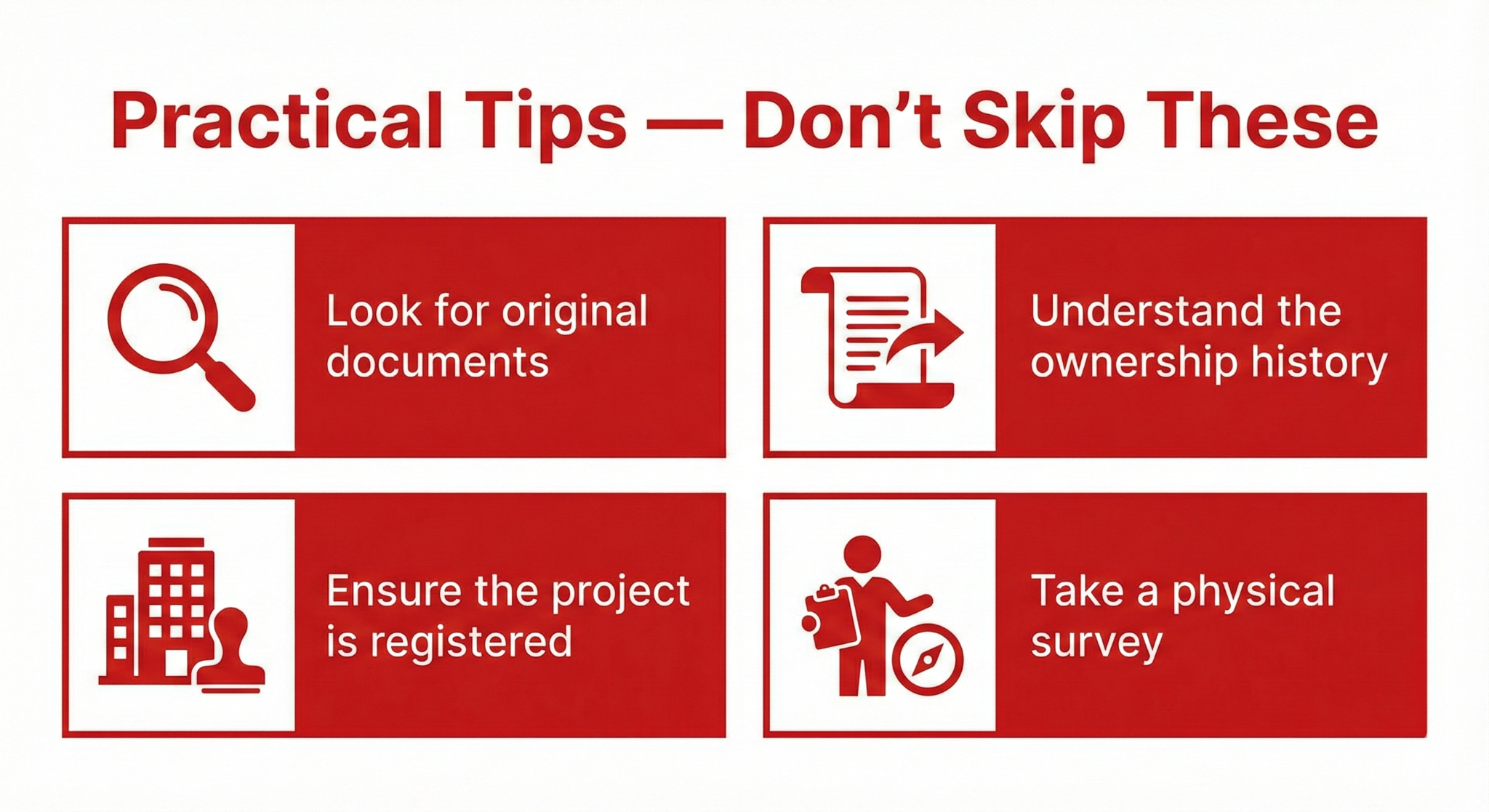
Practical Tips — Don’t Skip These
- Original documents (or certified copies) should always be requested, rather than photos or PDFs.
- Understanding the ownership history is important — most of the time, a “clean” title that is shown might have some loopholes in it. The “mother deed” acts like a guide to trace the older times.
- For builder‑flats or homes that are still under construction, make sure that the project is registered under the respective real‑estate regulation (for instance, RERA) and that the building plans & approvals are available.
- Don’t rely solely on documents. The land might be showing something totally different than what the documents say. You must check the land boundaries, neighbours, access roads, and so on.
- If your instincts say that something is wrong, take legal advice. Engaging a lawyer or legal expert for due diligence might be a little costly, but once the sale agreement is signed or the token amount is paid, it becomes difficult to back out.
Scenarios to Watch Out For
- A property situated on land that is primarily meant for agricultural purposes and has not been legally converted into a residential area — such properties are at a high risk of becoming invalidated.
- Projects or flats lacking proper building plan approvals or occupancy/completion certificates — commonly a red flag for illegal constructions.
- Properties that present a “clean” title but have limited document history — particularly those that are old and “mother deed” or chain-of-title records are not available. Always ask for historical ownership documentation.
How Neotown Helps
We at Neotown value transparency and clarity; therefore, we encourage the same to our clients and potential buyers. Before taking the next step, they may be assured of the authenticity of the property by a thorough legal property verification with us. Ways in which we can help you are:
- Know which papers to request
- Ensure that all permissions, fees, and records are up to date
We are not just the ones who sell you a property — Safe investment, peace of mind, and the enjoyment of your new home are what we also want for you.
FAQs
Q1: When verifying a title deed, ownership records should go back how many years?
Ownership records ideally should be tracked down to between 12 and 30 years ago, or at whatever point the records are available. It is mainly for this reason to find past disputes, transfers, or hidden claims on the property.
Q2: Is it enough to check an Encumbrance Certificate (EC) only to be sure that the property is legally clear?
No — even though it is very important (it shows mortgages, loans, registered claims), one still requires legal property verification, title deed, municipal / khata records, zoning permissions, and on-the-spot checks to be completely certain.
Q3: What should I do if a builder or seller says that the property is “clear,” but some documents are missing or not in place?
Consider that as a warning signal. Prior to committing, either ask for those papers or have a legal expert check them. In the absence of proper documentation, making any payment or signing increases the risk of subsequent problems considerably — regardless of how “good” the deal is.
Contact Us
📧 Email: info@theneotown.com
🌐 Website: www.theneotown.com
Also Read: Spacious Flats in Greater Noida with Premium Amenities: The NeoTown Project